I am writing this blog to share the truth about how we make sheepskin in our factory.
Many buyers ask me: "Why your sheepskin is soft?" or "Is it really eco-friendly?"
Today, I want to open our factory door for you. I want to explain step-by-step. No hiding secrets.
In the old days, making fur and leather was a dirty job. We know this.
But now, China changes a lot. Our factory also changes. We don't use the old bad chemicals anymore.
We use a new technology called "White Tanning" (Phosphonium Tanning).
It is clean, safe, and makes the wool very beautiful.
Below is our full production line story.
It is long, because making good sheepskin is not easy.
It needs about 29 steps.

Tanning is the most decisive step in sheepskin manufacturing.
If skin is not tanned, it is just "raw skin"—easy to rot, stiff, and you cannot use it.
After tanning, the leather board gets softness, good storage stability, wash resistance, and good breathability.
It becomes the real fur material for clothes and daily life products.
To understand our quality, you need to know a little history.
The process has gone through several phases:
Very Old Time (Oil Tanning):
Long time ago, people use animal oil to tan skin.
It uses aldehydes produced by animal fat oxidation to cross-link the fibers.
It is okay, but not stable enough for fashion coats.
Old Time (Vegetable Tanning):
Using tree bark (Tannins). This is a classic method.
But the process cycle is long, and the skin becomes firm/stiff, usually brown/yellow.
Good for horse saddles or leather carving, not good for soft sheepskin rugs or garments.
Modern Time (Chrome Tanning):
This is what most people used for shoes leather.
It is strong, low cost, and fast.
But it has a big problem with hexavalent Chromium wastewater treatment.
Old White Way (Aldehyde Tanning):
Using chemicals like Glutaraldehyde.
Color is white, softness is high.
But there is the problem of aldehyde residue.It is gradually being replaced.
We used this method ten years ago.
Now We Use (White Tanning):
This is the best technology now, for clean production.
We use new tanning agents with No Chrome, Low Aldehyde, or No Aldehyde.
The skin comes out white, clean, and safe for baby use.
→ Our factory uses the Phosphonium-based White Tanning agent.
It is transparent, easily soluble in water, and pH neutral.
It contains No Chrome and No Free Aldehyde.
This is the main clean tanning material promoted in the fur industry today.
This is the new standard for "Clean Production" in China.
Because our environmental laws are very strict now, we moved to this system to reduce pollution and make a safer product for you.
(I explain this very simple, so you can understand what we do every day)
The White Tanning process is made of 3 parts:
Preparation Phase → Tanning Phase → Finishing Phase.
1. Pre-treatment (Sorting)
When raw skins come to our warehouse, they are dirty and salted.We must check one by one.
We remove the salt and cut off the bad parts. If the raw skin is bad, the final product will be bad.
We only pick the good ones to put in machine.
2. Pre-soaking (Drinking water)
We put the raw skin into the water tank and stir it.
We let the skin surface absorb water to recover to the state of "fresh skin."
This helps us wash away mud, dung, blood, and dirt hidden inside the skin, and it helps soluble proteins decompose.
- Factory Note: We add a small amount of surfactant and grease dispersing agent in clear water.
- Important:We avoid high temperature or strong alkali to prevent the sheep wool from curling or getting damaged.
3. Wet Burr Removal (Scraping Grass Seeds)
We must remove grass seeds and plant thorns stuck in the wool.
This is to prevent them from damaging our machine tools or the skin board in later operations.
- How we do it: We take a scraping knife (plastic or blunt metal knife). We scrape lightly following the wool direction.
Scrape 2–3 times until you see the grass seeds gather at the wool tip, then wash away with water or remove the impurities by hand.
- Rules: Do not scrape against the wool (it will pull the hair out), do not use too sharp a knife (it hurts the wool root),
must scrape on wet skin (not dry skin), and do not press the knife hard like scraping meat (the force must be completely different).
4. Hydro-Extraction (Spinning)
Spin out the surface water. This is to reduce wool sticking together when we do wet shearing next.
5. Wet Shearing (Only for short wool products )
We trim the wool length to make it tidy. This helps the chemicals penetrate evenly later.
Cutting must be uniform, do not cut the wool root or skin board.
6. Second Soaking (Deep Drink)
We soak the skin again. This time is longer.
We want the skin to be fully open and soft, just like fresh skin from the animal.
We use recycled water here because we want to save water for our earth.
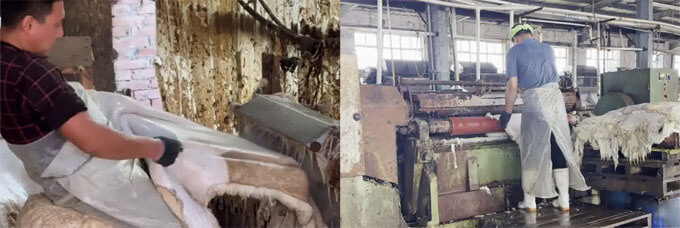
7. Fleshing / Trimming / Shaving
Fleshing: Cleaning off the meat dregs, fat, and fascia from the backside.
Trimming: Cutting off ragged edges.
Shaving: Making the thickness even.
If one part is thick and one part is thin, the color will look different later.
- We use a Fleshing Machine or manual scraper.
- The worker must be skilled, We must clean the meat but never cut through the reticular layer
(the net-like layer that gives leather its strength).

Sheepskin has a lot of natural grease (lanolin). We must wash this oil out.
If we leave the oil inside, the sheepskin will smell bad in future.
While scraping the oil, we also "open up" the pores on the skin board.
This lays a good foundation for the next step (tanning), letting the chemicals be absorbed more evenly.
- Factory Talk: This is said to be the dirtiest and most tiring job.
The master uses a specialized machine to squeeze and scrape the grease out, layer by layer.
- Eco Note: The grease scraped down is not wasted! After deep processing, it can be made into soap and skincare products.
- The cleaning liquid used here comes from recycled re-soaking cleaning liquid.
The wastewater after cleaning here goes back to be used as pre-soaking cleaning liquid.
9. Third Soaking (Final Soaking)
We check the skin again.
We cut a small piece to see if the cross-section of the skin board is semi-transparent or micro-transparent, and full of water.
if yes, it is ready for the acid softening..
10. Softening & Pickling + Resting
- Softening: We use Protease (Enzyme).
Its function is to gently decompose non-structural protein, making the skin fiber loose and soft.
Because we must keep the wool, the enzyme used must have no destructive effect on keratin (wool).
We mostly use weak protease or neutral enzyme.
The pH is generally neutral or weak alkaline (pH 7–8) to avoid hurting the wool root.
We can add a little Sodium Carbonate to adjust the weak alkali to make the enzyme more effective.
This makes the skin fiber "open up".
Imagine the skin fiber is a door, the acid opens the door so the tanning material can go inside.
We add acid very slowly to prevent "acid shock" (making the skin brittle).
This step also stops the remaining effect of the enzyme, protecting the hair from continued decomposition.
We control the ratio of salt and acid to prevent the skin board from expanding too much.
Phase 2: Tanning Stage (Making it Stable)
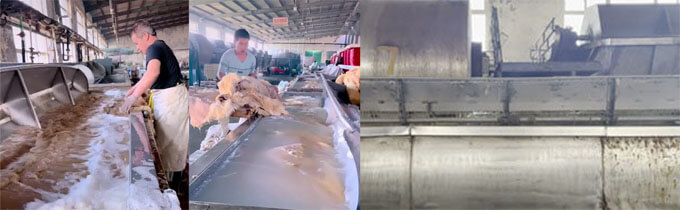
11. White Tanning (Adding Phosphonium)
This is the main step. We add the White Tanning agent (Phosphonium salt).
It goes into the fiber and connects with the protein.
Why is it good? It makes the skin strong, heat resistant, and keeps the color very white. No Chrome involved.
12. Resting (Sleep time)
After adding chemical, we cannot rush. We let the skins pile up and "sleep" (rest).
This let the chemical go deep into the center of the skin.
If we skip this, the center of skin will be raw.
13. Oiling (Fatliquoring)
Tanned skin is stable but maybe a little stiff.
We need to add "good oil" back. We use special oil for leather- sheepskin-friendly oil (Silicon-based or animal oil).
We put this oil only on the skin side, careful not to dirty the wool.
This makes the leather stretch and soft.
14. Spray Water
We spray water to make the skin board humidity suitable for the wet buffing operation.
Spray evenly, cannot be locally too wet.
15. Wet Buffing (Grinding)
We use a machine to grind the backside (flesh side).
It cleans the surface and makes it feel like velvet/suede.
Warning: We tell workers must be gentle. Do not grind to the hair root!
16. Water Washing
We remove the dust produced by grinding and residual chemicals.
17. Oxidation (Removing Yellow)
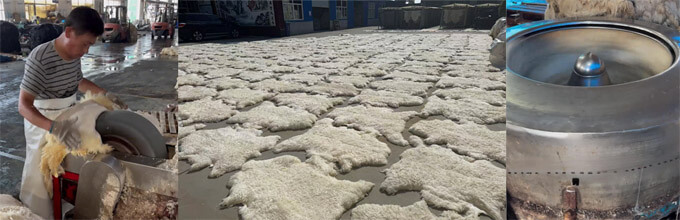
This is a special step. We use Hydrogen Peroxide to remove urine yellow and pollution on the fur surface.
This improves the wool color and prepares for bleaching.
- We must strictly control the concentration to avoid burning the wool.
- Factory Insight: This process needs Sunlight.
We put the wool side to dry in the sun, and the more sun, the better the effect !
18. Water Washing
We must wash very clean.
After washing, the skin board should not have acid smell or chemical residue.
The skin must be pH neutral (safe for skin) .
19. Hydro-Extraction (Spinning)
We remove the excess water. Good for drying later.
20. Fatliquoring (Final Oiling)
We add one last layer of softener (like Lanolin) to the leather side.
This makes sure when it dries, it is not like cardboard, but like soft cloth.
Phase 3: Finishing Phase (The Beauty Salon)
21. Drying, Stretching, Nailing
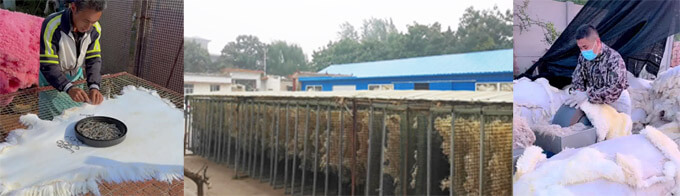
We stretch the skin on a net and use hooks to hold the edge.Or we use toggle clips.
We dry them in the shade or a ventilated room.
Note: No hot sun! No high heat! That will kill the leather.
We want natural drying to keep it flat and smooth.
22. Dampening (Add little water)
After drying, the sheepskin is stiff.
To keep a certain flexibility, we need to spray a small amount of water again.
Spray must be even, cannot be locally too wet.
23. Staking (Beating the skin)
A machine beats and massages the skin.
This breaks the hard fiber sticking together.
After this, the skin becomes very soft and flexible.
You can feel the difference by hand immediately.
24. Edge Trimming
We make the edges neat and meet the specifications.
25. First Shearing
We cut the wool length to make it almost even.
26.Ironing and combing
This is like hair salon for sheep.
Ironing: We use hot roller to press the wool,that is a hot ironing machine (120°C - 180°C, depending on wool type).
This makes the wool straight, shiny and fluffy.
combing: We use brush machine to comb the wool, remove tangles.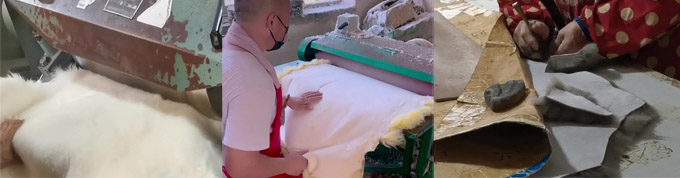
27. Second Shearing
Now the wool is standing straight, we cut it one last time. Very precise.
The surface looks like a smooth carpet.
28. Final Finishing
Workers check the skin by hand.
They blow away loose hair, brush the wool direction, and fix small defects.
29. Inspection, Measurement, Packing
This is the end.
Our QC team checks the color, softness, wool length, and skin board quality.
We classify by size and grade, If it is Grade A, we pack for rug.
If it is Grade B, we separate it.
- No Chrome.
- Low Aldehyde.
- Avoids heavy metal pollution to wool.
- High biodegradability.
- Tanning agent utilization rate is high (>$85%$).
- The finished product is safer, with less irritation.
We use Phosphonium-based White Tanning. This makes our factory's wastewater easier to handle:
- COD/BOD: Dropped by 30–50% compared to Aldehyde tanning.
- Phosphorus Content: About 5–8 mg/L (low amount).
- No Heavy Metals: No Chrome.
- Small Wastewater Volume: Less than 50 Liters per skin.
- Low Cost: Treatment cost is low, and there is no secondary pollution.
- Recycling: After treatment, water can be reused for cleaning.This helps us work towards Zero Emission.
So, this is how we work. It is a long process, usually takes many days.
But we don't skip steps.
We know you are international buyer, you need quality and safety.
We are a factory, We make the product with our hands.
If you are looking for a partner who is honest and uses clean technology, please talk to us.
We can send you sample so you can touch the quality yourself.
We are always happy to welcome international friends to China to see the "sun bath" oxidation or the "dirty" degreasing work with your own eyes!


